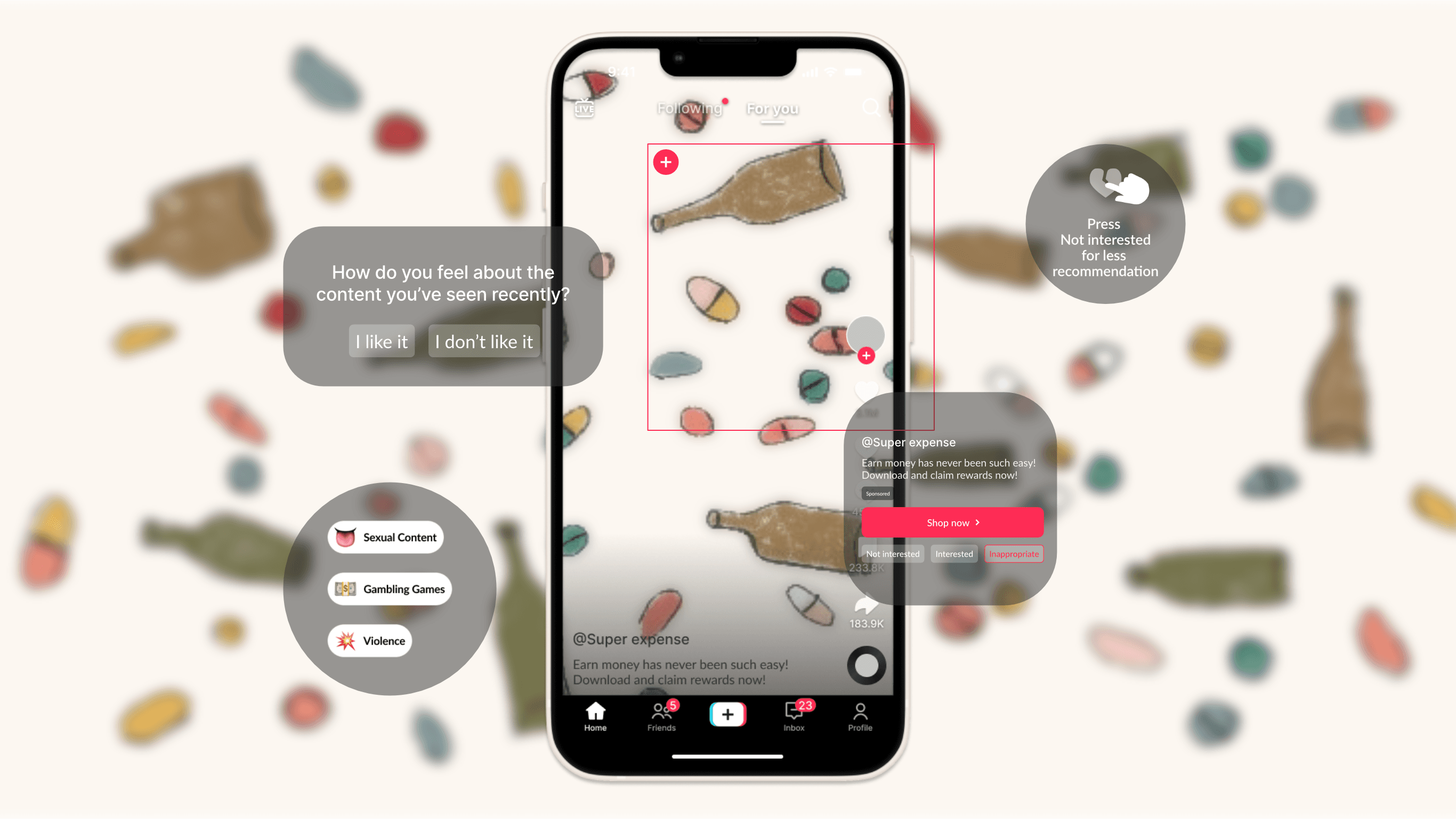
THE CHALLENGE
Bias brings users convenience through accurate recommendations while potentially harming them from different perspectives. How does harmful biases in TikTok’s Algorithmic Systems affect user experience?PROBLEM STATEMENT
We tested the usability on current TikTok functionalities to find the bias issue among the users.-
Racial Bias: TikTok only recommend posts about users' own race to experienced participants but recommend posts of other races to the naive participants. Some participants swipe away the other races’ posts because they feel these posts don’t fit their lifestyle.
-
Gender Bias: The male participants got advertisements about sport shoes, games and sexual contexts, while the female participants got advertisements about cosmetics and shopping malls.
-
Brand Bias: TikTok only recommends certain brands of products to participants, which including electronic device and food in our test.
-
Need Bias: Participants kept receiving ads on the products they don’t want or need to buy. Even though participants pressed "not interested" to these items, TikTok still recommended these items to them.
-
Negative Action to Biased Ads: Most participants only stay a short time on biased advertisement and swiped them away. Few of them tried to disinterest the first few biased advertisements they saw but gave up after a while.
RESEARCH GOALS
How might we support users by personalizing their advertisement settings while facing potential algorithm bias?QUALITATIVE ANALYSIS
We have conducted 3 rounds of interview, including a Think-aloud protocol, a pilot testing interview, and a semi-structured interview with direct-storytelling method on 3 participants.We collected interpretation notes from those interviews, analyzed them through Affinity Diagram and User Journey Map, and generated higher levels of insights. Here are a few questions that we pay most attention to:
-
"How do you feel about the advertisement in TikTok regarding algorithm bias?"
-
"How do you feel about the current advertisement setting user flow? You can share both the positive and negative views with us."
-
"Are there more functionalities about advertisement you wish TikTok to add in the future? Why? How do you think this can contribute to deal with the algorithm bias and make the algorithm suit your needs?"
-
"Is there any concern for the possible functionality you just mentioned?"
-
"What improvement would you like us to do to the advertisement setting interface/user flow?"
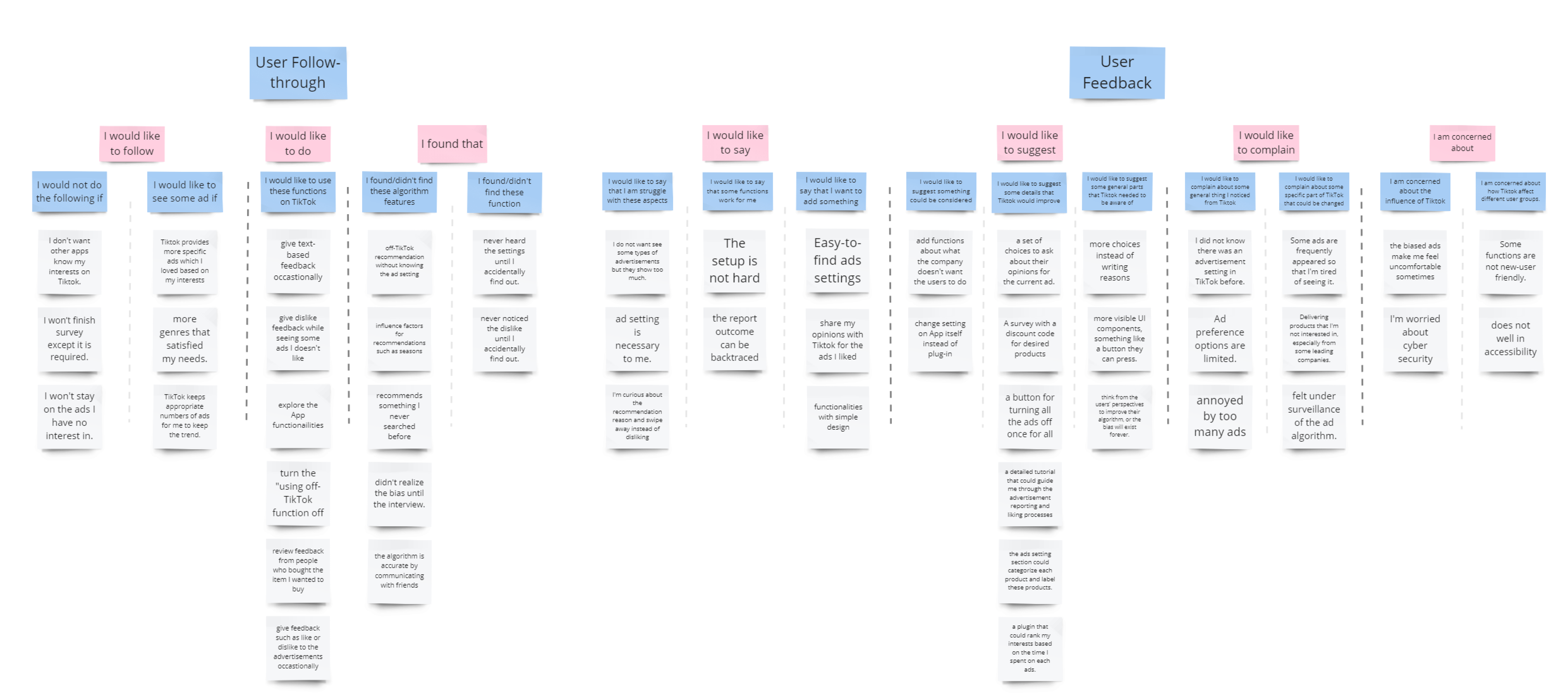
Data analysis and synthesis - Interpretation Session + Affinity Diagram
Through interpretation session, we analyze users' need, motivation and behavior, then we grouped and labeled them in an affinity diagram, synthesizing the insights in first-person angle. Users claimed their preference, activities and findings in TikTok, shared their needs, suggestion, complaint, and concern.
Affinity Diagram
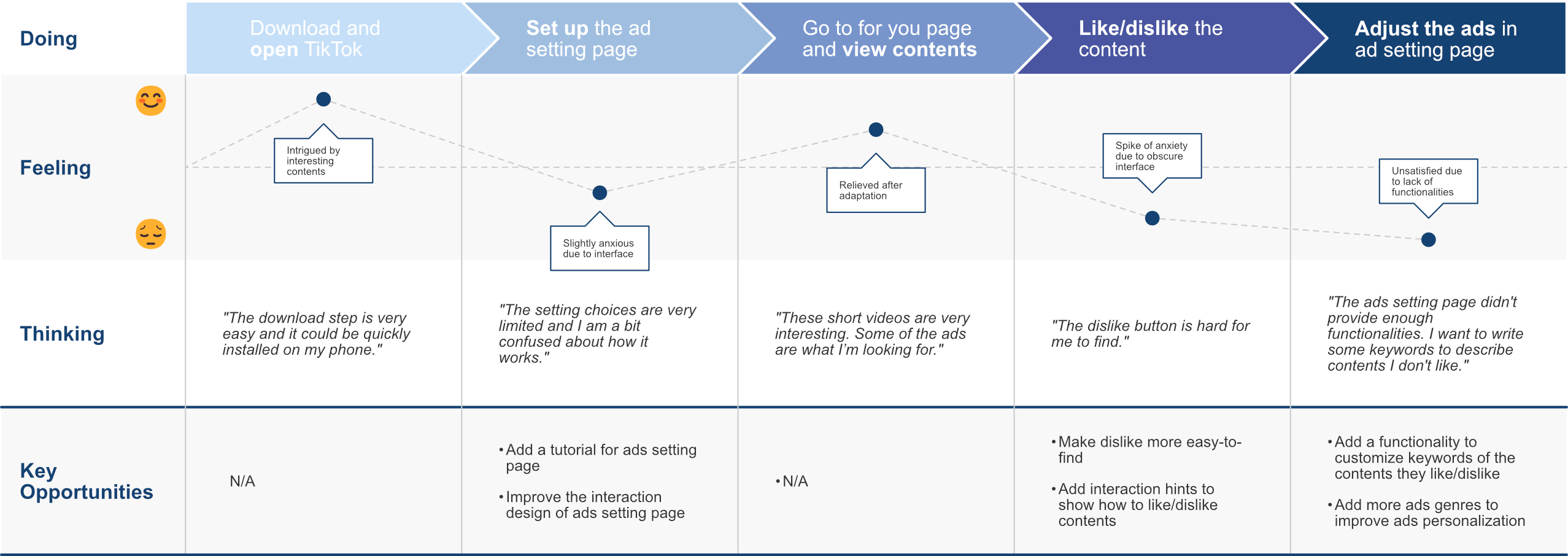
Models - User Journey Map
We built models, user journey map, to help us better summarize and understand users' stance from the interview. This bridges the opinions from users and the following speed dating design implications.
User journey map
QUANTITATIVE ANALYSIS
We have also conducted a survey with 13 questions in 3 categories: app features, advertisements and purchase behaviors on Google Forms to verify our preliminary insights from qualitative research. We received 32 responses, and these results helped us iterate on our insights and following speed dating session.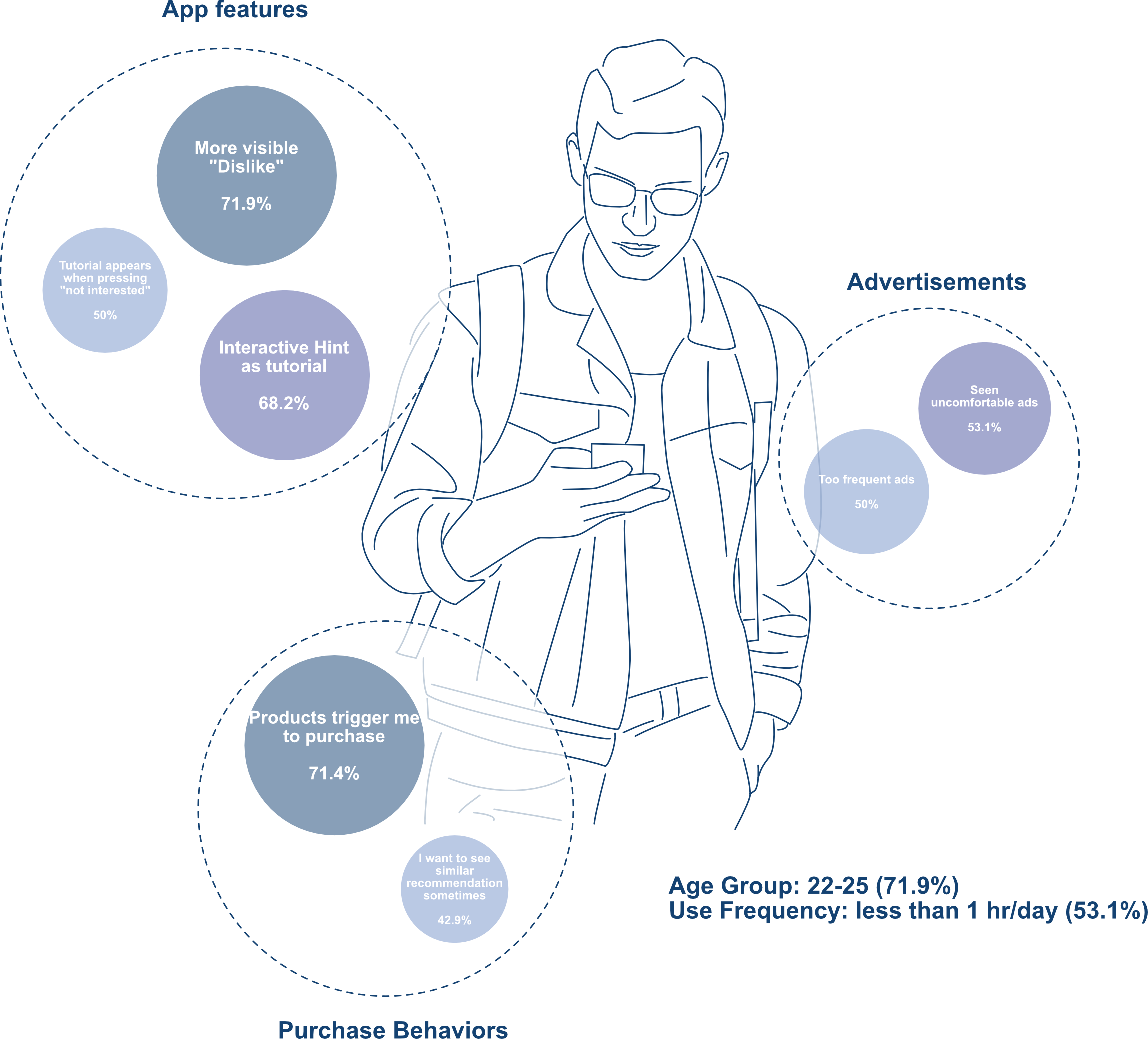
Survey Result
-
Most of our participants are between 22-25 years old and use TikTok less than an hour every day.
-
The survey proves our findings from the interview about the current issues of ad settings and people’s strong need for a tutorial. The ad settings should be easier to find, and the interactive hints are popular among respondents.
-
The survey verifies that people encounter biased ads on TikTok despite sometimes never realizing it, including buying products from ads (good bias) and receiving inappropriate or fake ads (harmful bias).
-
The survey unveils respondents’ interest to recommendation ads when they use TikTok to purchase items.
INSIGHTS
-
Good and bad bias: Users enjoy advertisements with good bias and acknowledge bias-related issues despite not realizing them sometimes.
-
Desire to mitigate bias: Personalizing interested categories reflects users' desire to mitigate the bias by controlling the advertisement types they encounter.
-
Diverse ad preference setting: Users welcome diverse advertisement preference-setting mechanisms but prefer simple and intuitive ones.
-
Need for improved navigation: Deep nested ad-related operations and settings create a cumbersome personalization experience for users, leading to a need for improved navigation.
-
Seamless function integration: Seamless experience when using TikTok requires the integration of personalization features and existing functionalities.
LOW-FIDELITY PROTOTYPE
Speed Dating
We used speed dating on our insights to help us explore possible futures, validate needs and identify risk factors. The first one is recognized by most participants.
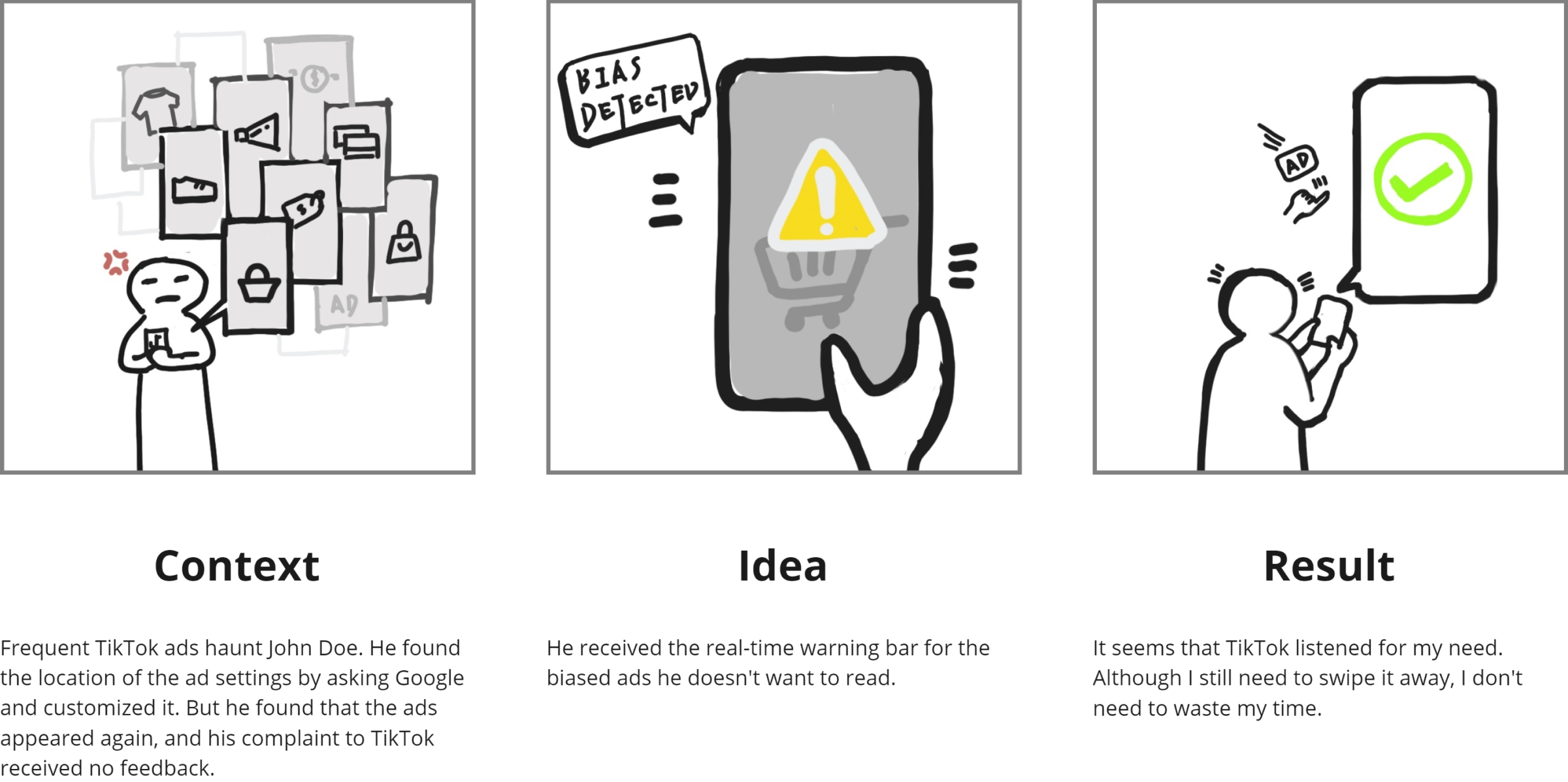
- Most participants express interest in real-time feedback from TikTok.
- Users prefer simple and intuitive functionalities.
- Users prefer simple interactions on their TikTok “For You” page.
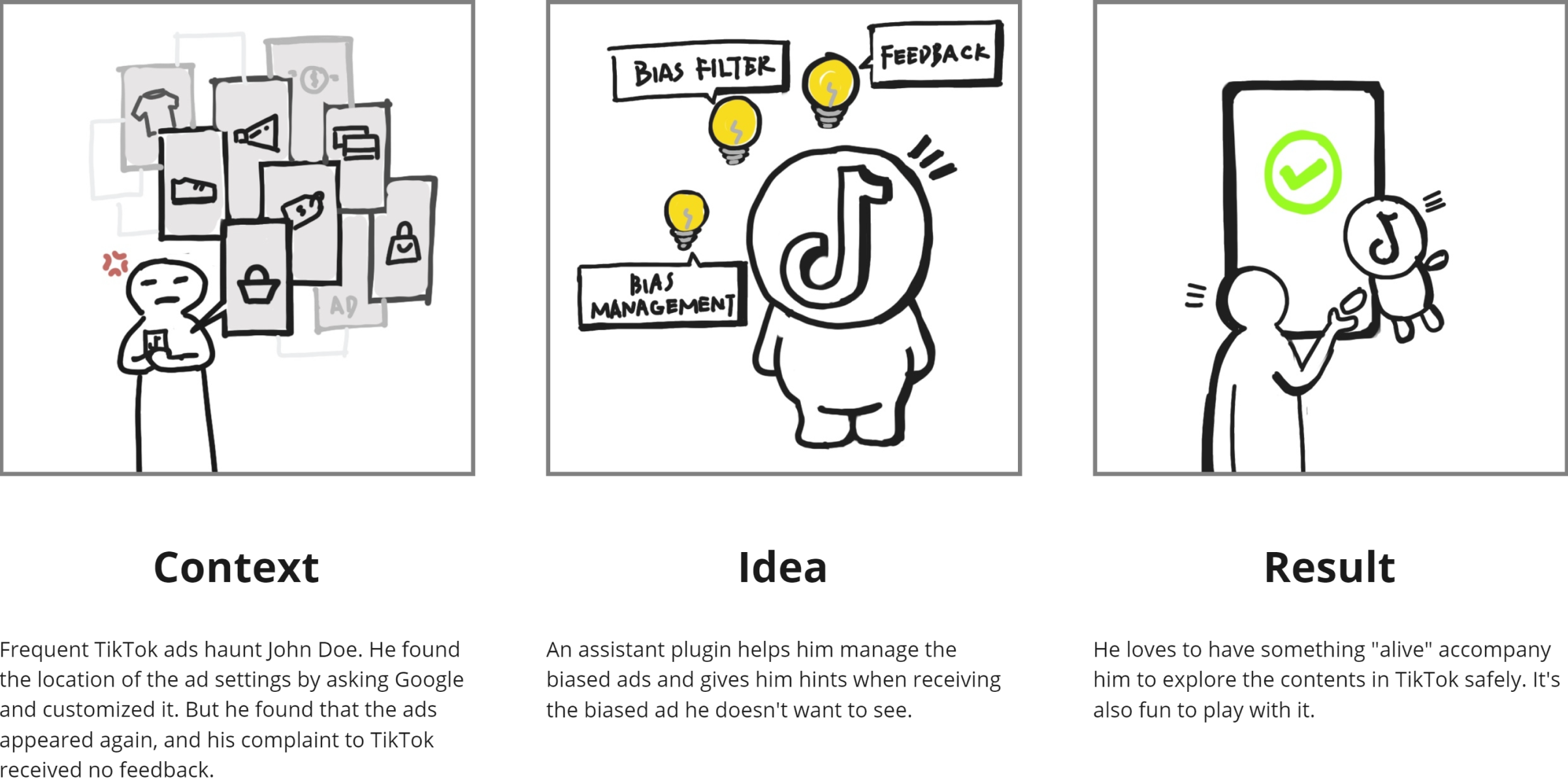
- We expected users to consider adding a plugin to eliminate ad biases, but most regard it as too complex and unnecessary.
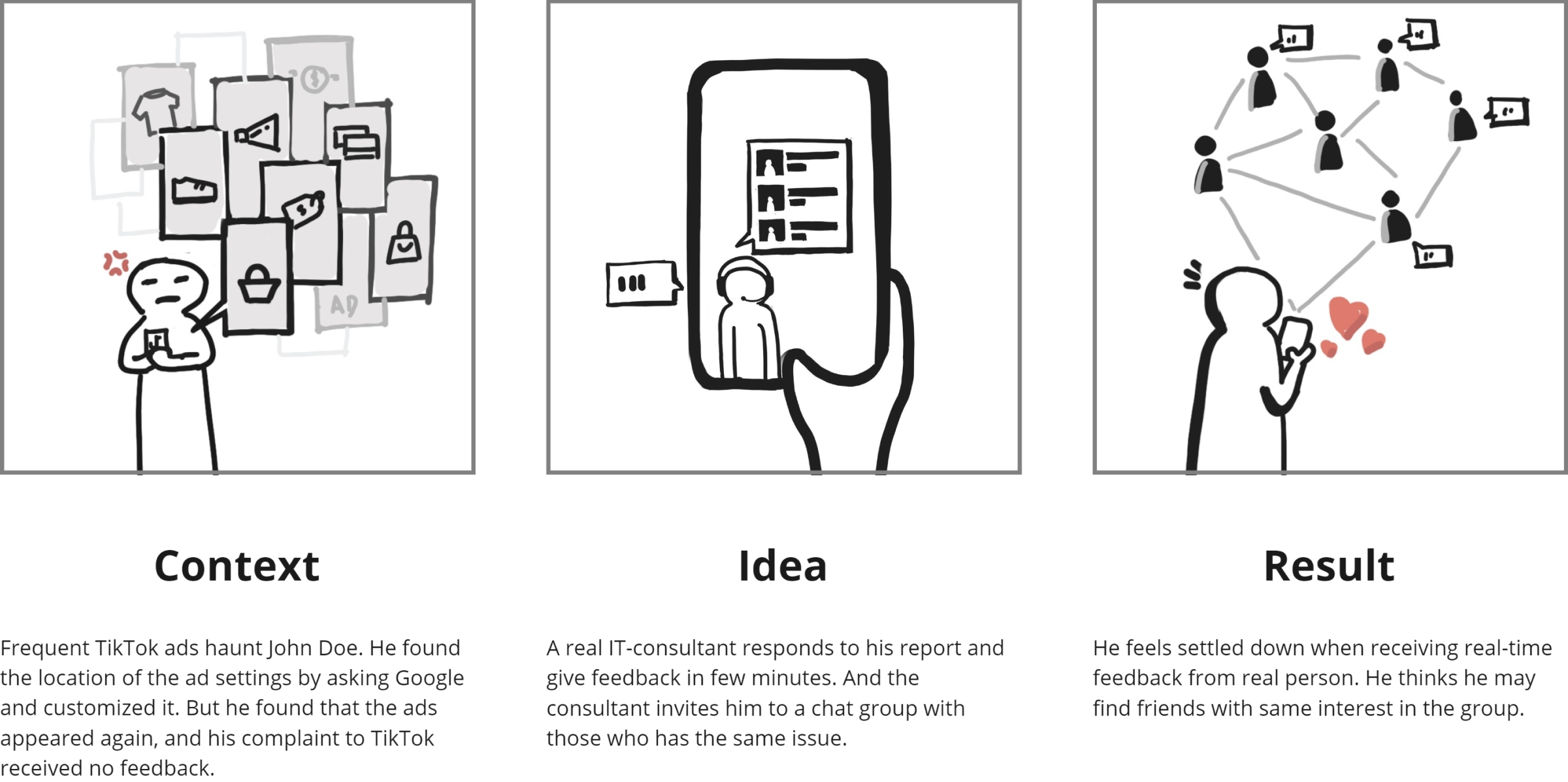
- Despite the surprise the sharing preference idea brings, users mostly feel weird about it.
- It triggers their unsettledness towards privacy and daily social interaction pattern.
Low-Fidelity Prototype
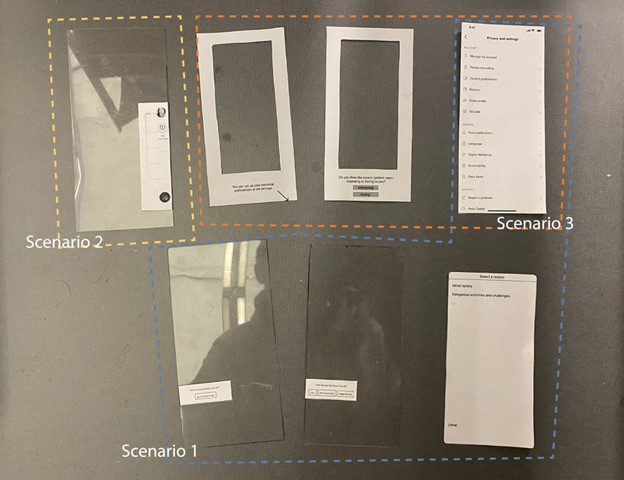
Building on the initial speed dating concept, we conducted a contextual prototyping session using our lo-fi prototype with 7 participants. During these sessions, we identified three critical moments in their user experience: the moment they open TikTok, when they scroll consecutively, and when they watch an ad to the end multiple times. To further explore these moments, we created a physical overlay for our interactive hints and tested them in real-life environments where people typically use TikTok, directly on participants’ phones.
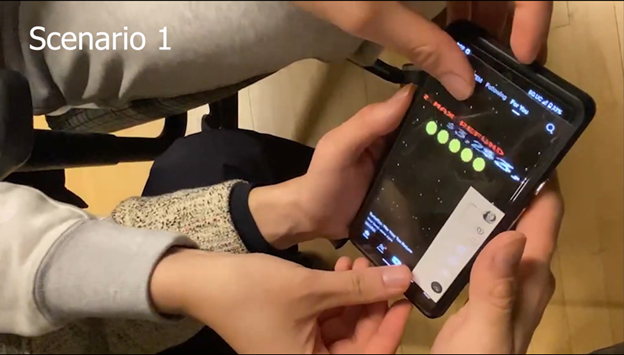
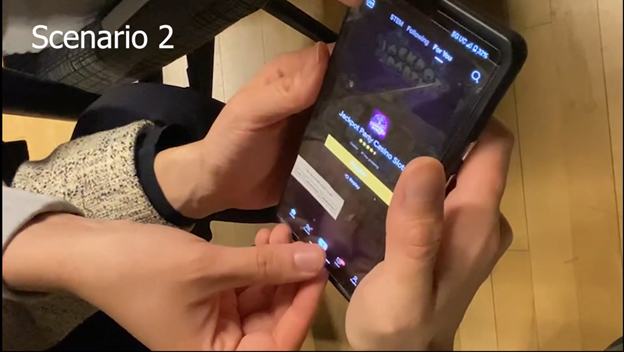
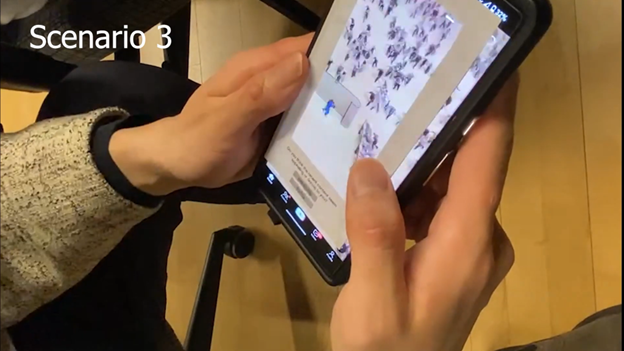
Evalulation
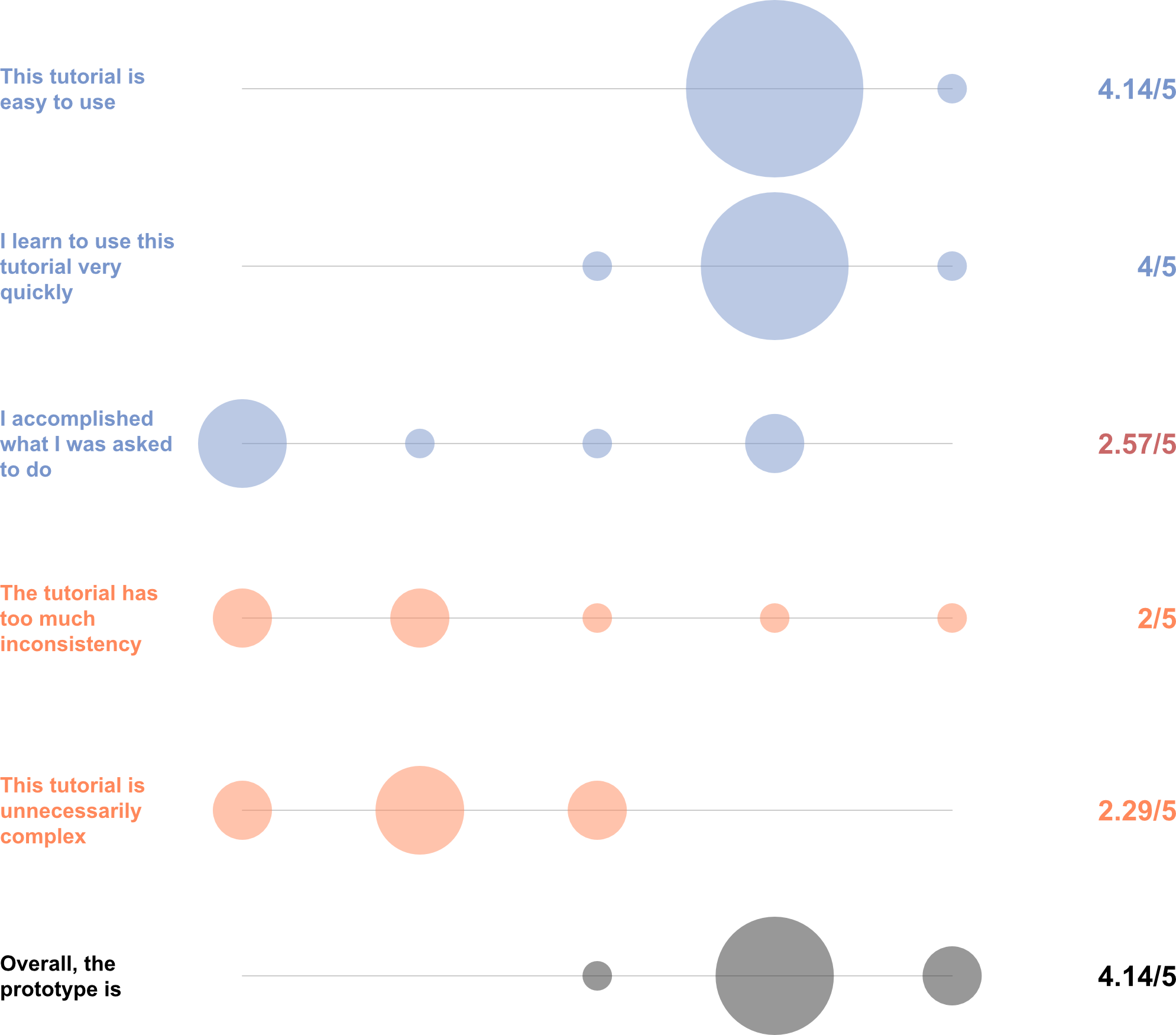
The overall feedback of the prototyping session is positive, our solution increased users' satisfaction a lot. But there are some flaws in physical prototyping process design, which affect the workflow consistency. Considering the final deliver method, the positive feedback weighted more on our final decision.
Evaluation Result
FINAL DESIGN PROTOTYPE
Here we present our final design solutions for biased ad personalization. Since our solution is represented in the form of extension, we leverage the similar component/style of current TikTok UI design and integrate our extension into the current user flow.SCENARIO 1:
TUTORIAL
We’ve moved the deeply nested "Not Interested" button to the right-hand column, positioned next to the "Like" button. When users open TikTok for the first time, the extension will display an overlay tutorial explaining its functionality.
SCENARIO 2:
INTERACTIVE HINTS
As users continue scrolling through videos, interactive hints will appear. Depending on their choice, the extension will respond differently by either adjusting recommendations (showing fewer or more of similar content) or navigating to the report page.
SCENARIO 3:
PERSONALIZATION
If users continue watching an ad without taking any action several times, the extension will prompt them to specify their preferences and guide them to the ad personalization page. Here, users can customize their preferences by selecting personalized tags, giving them more control over the ads they see.