BACKGROUND
Physical activity play (PAP) is a form of play that emphasizes dynamic engagement, physical coordination, and spatial interaction. It is vital for children’s physical, cognitive, and social development. Outdoor PAP is declining due to various constraints, making the home an increasingly important but underexamined setting for children’s play.
Current HCI research mostly target outdoor contexts and peer interaction. Meanwhile, AI is becoming more present in children’s everyday lives, but its potential in guiding domestic PAP, and the dynamics between children, parents, and AI, remains underexplored.
Thus, we aim to investigate how PAP is currently practiced at home, what are parents and children’s roles, and what needs and challenges emerge in these contexts.
METHOD
LMM(Large Multimodal Model)-based AI chatbots (Doubao1) are used as accessible entry points to help participants recall their experience and explore new forms of AI interaction.
Design Ethnography
- AI Prompts Co-Design: Parents (and children) then worked with researchers to brainstorm prompts, guided by a design framework.
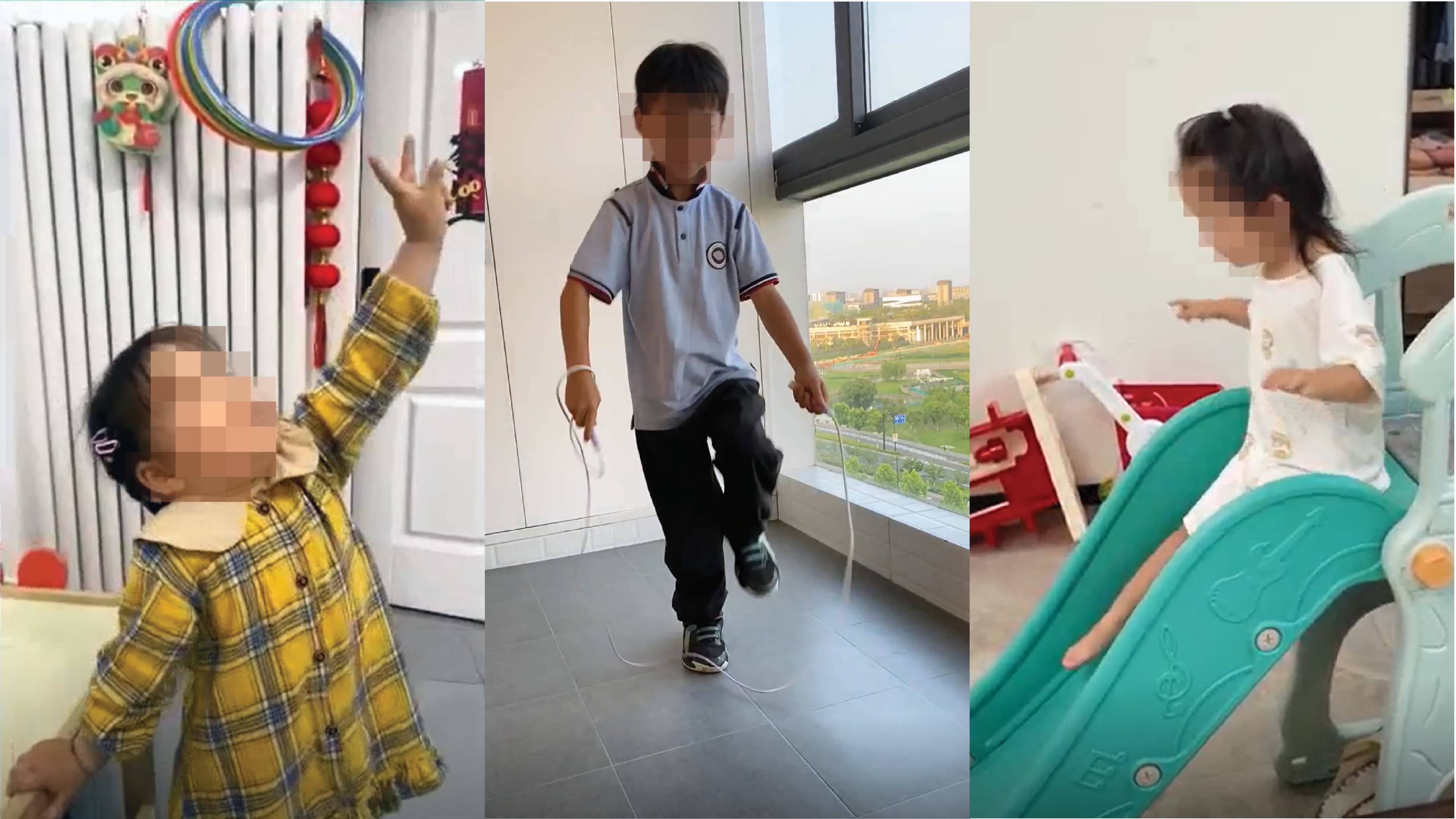
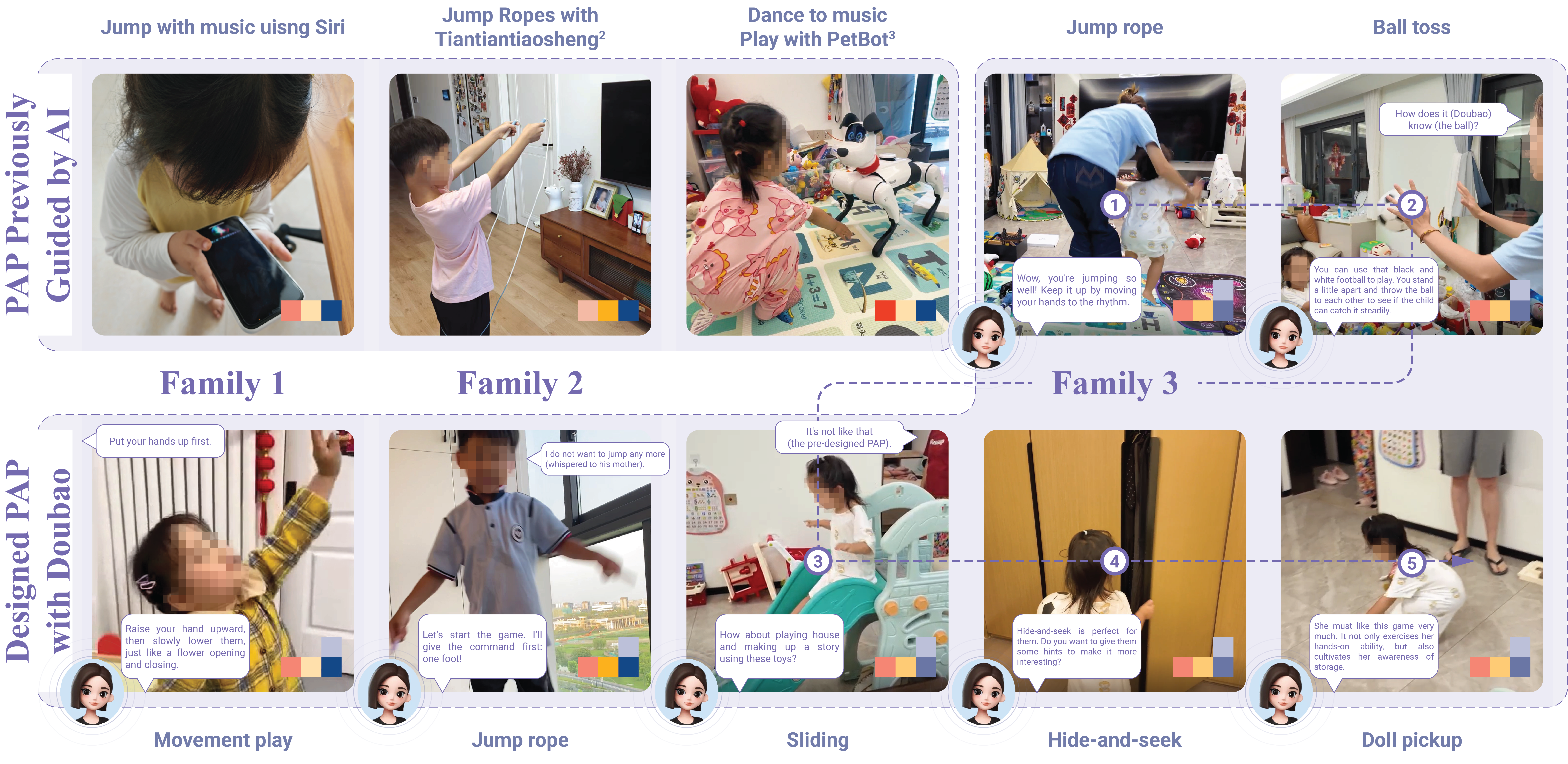
- Family Play Observation: Parents and children play with the AI chatbot using the prompts developed earlier.
Semi-Structured Interview
- Parent-guided children interview and co-creation.
- Parent Interview: Comparison of different AI systems, discussion of their roles in play, and their needs, challenges, and long-term expectations for AI in supporting PAP at home.
FINDINGS
AI-Supported PAP Practices
- AI takes multiple forms: physically-embodied, interface-mediated, and environment-situated.
- AI supports structured, open-ended, and free play.
- Location depends on AI forms.
- Duration varies by structure.
Parents’ and Children’s Role
- Parents shift between bystanders, co-players, and interpreters.
- Children’s embodied intentions are lost and suppressed through parental translation.
- Children’s communication gap and AI literacy limit their direct engagement with AI.
Limitations of AI Capabilities
- Play flows are easily disrupted when AI responses fail to maintain relevance to PAP activity.
- AI systems struggle to sense and adapt to children’s physical states, particularly fatigue.
DISCUSSION AND FUTURE WORK
-
AI systems should preserve children’s embodied intentions by supporting child-initiated, self-directed play and giving children more autonomy beyond filtering ideas through parental expectations.
-
AI systems should respect the flexible, context-rich nature of PAP by sustaining coherent play flows and equipping multimodal sensing to detect shifts in children’s physical states.
-
AI systems should balance its roles with parents, preventing parental withdrawal and fostering healthier parent–child–AI co-play dynamics.
-
Future studies should refine protocols to account for participants’ limited AI literacy and children’s developmental stages, and also examine long-term parent–child–AI dynamics to better inform the design of AI systems for PAP at home.