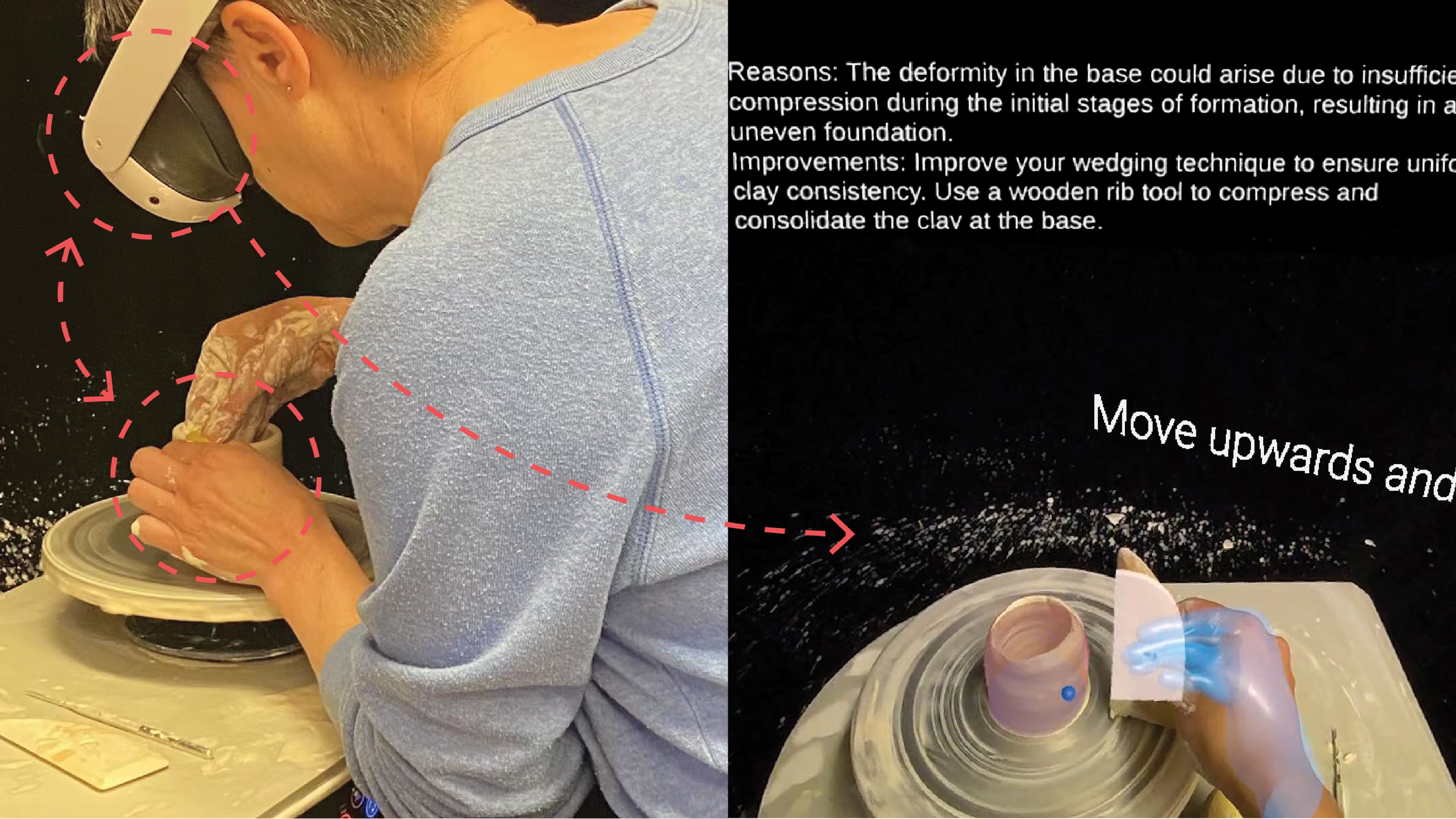
BACKGROUND
Craft learning has expanded from traditional in-person instruction to various forms of remote and self-directed learning and practice, allowing a broader audience to explore craft at different skill levels.However, achieving mastery remains difficult due to the challenge of acquiring tacit knowledge:
- complex and nuanced coordination of body, material, and tools (somatic);
- reflection on ”critical incidents” in complex craft processes characterized by “workmanship of risk” (relational);
- the social dynamics of instructor-learner models in studio environments (collective).

RESEARCH QUESTIONS
What does the interplay between AI-augmented Mixed Reality systems and embodied craft practices reveal about the evolving roles of systems, learners, and practitioners?
- (RQ 1) How does the interplay between AI-augmented MR technology and the embodied nature of craft learning influence the design of instructions?
- (RQ 2) How do novice and experienced ceramicists perceive the system’s ability to support craft learning, and how do they envision its role in future practice?
- (RQ 3) What broader impacts emerge as AI-MR systems and craft practices co-evolve to challenge existing roles and processes in craft practice?
METHOD
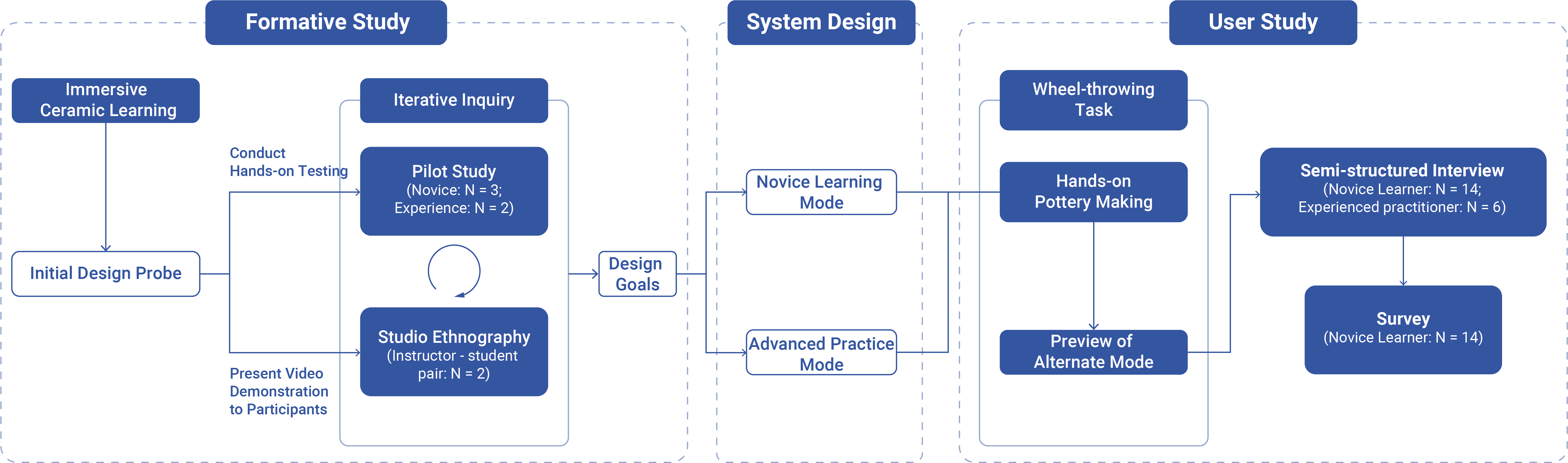
To explore our research questions, we adopted a Research-through-Design approach comprising three phases: formative study, system design, and user study.
Formative Study
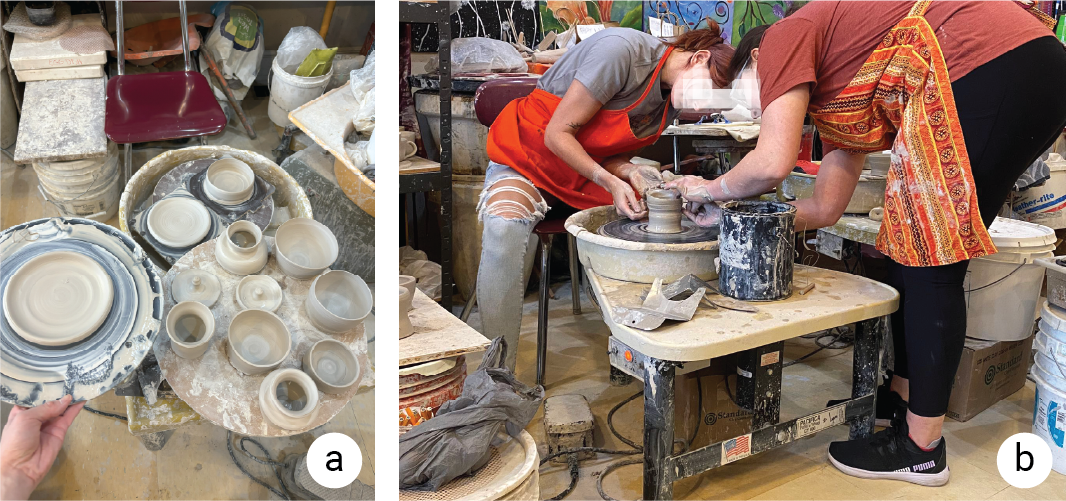
On-site study of the ceramic learning process: (a) Outcomes from our immersive ceramic learning in the studio; (b) Interaction between learners and instructors during an ethnographic study session.
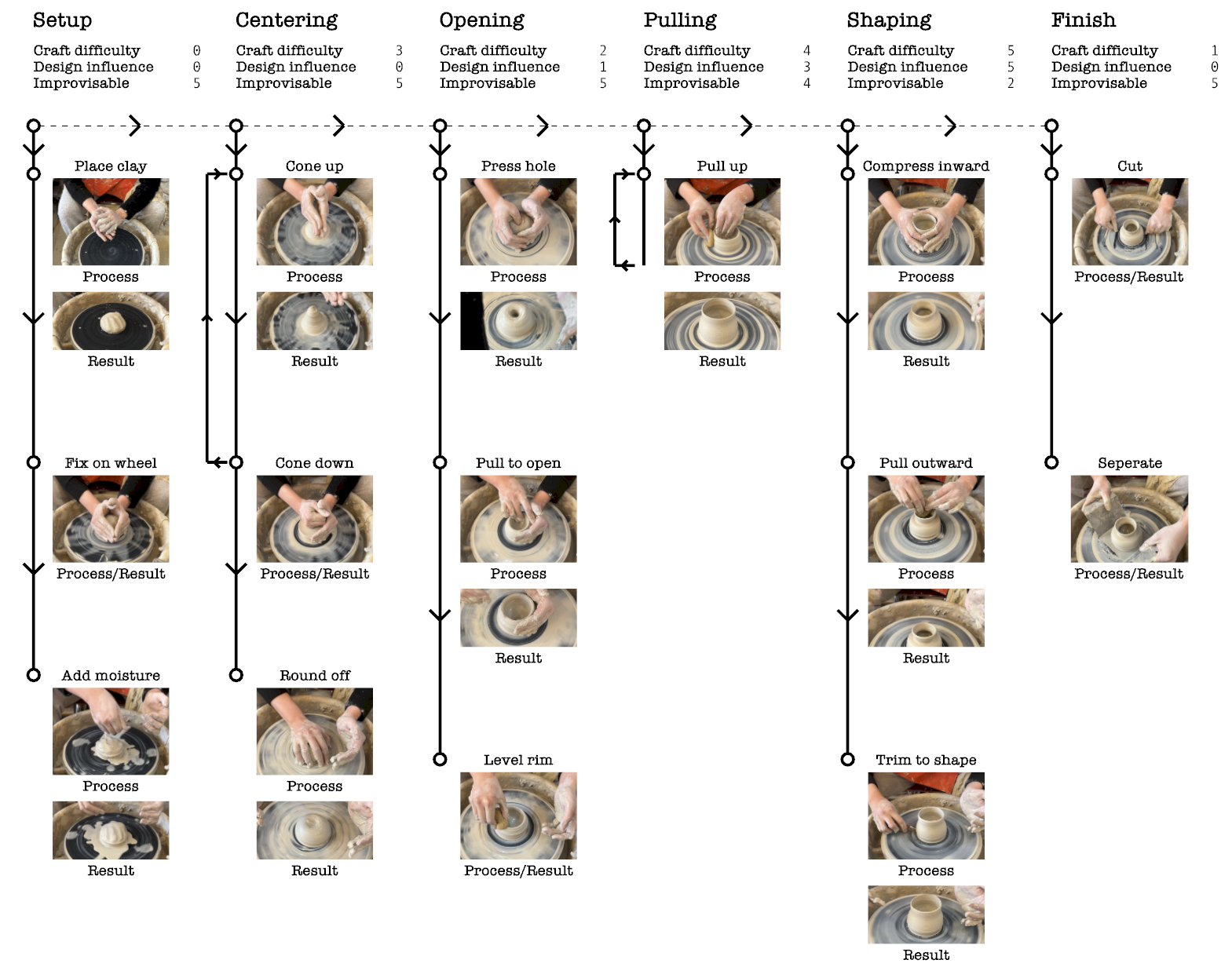
Schematic diagram of each step in wheel-throwing: The entire process is divided into the following steps: (1) Setup: Anchoring the clay. (2) Centering: Ensuring the clay is balanced on the wheel. (3) Opening: Creating the initial cavity. (4) Pulling Up: Raising the walls to the desired height. (5) Shaping: Creating specific shapes, such as the neck for vases. (6) Finishing: Removing the completed piece from the wheel.
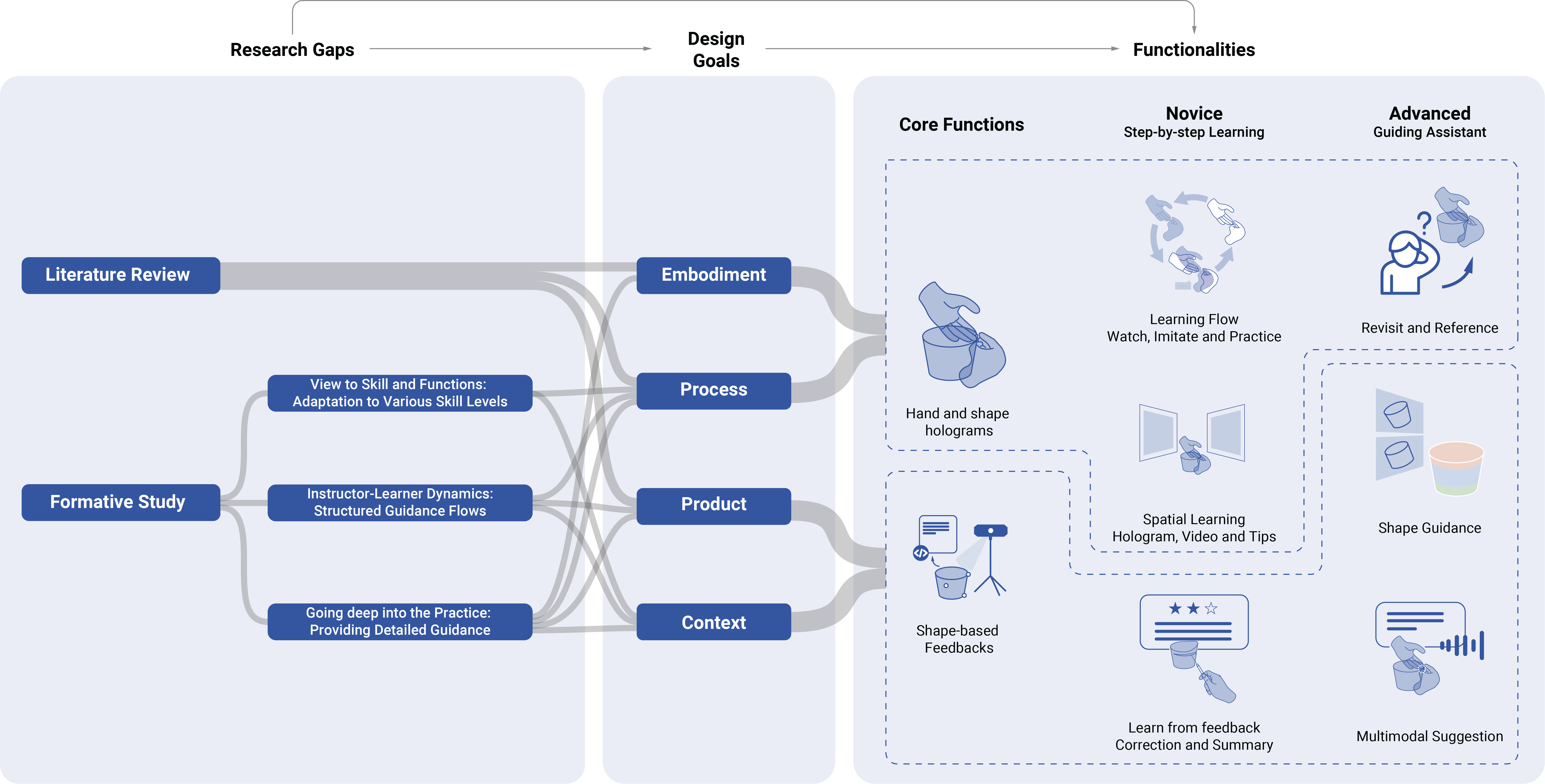
Overview of the system design process across three phases: identifying research gaps through a literature review and formative study, defining design goals, and developing the system.
System Design
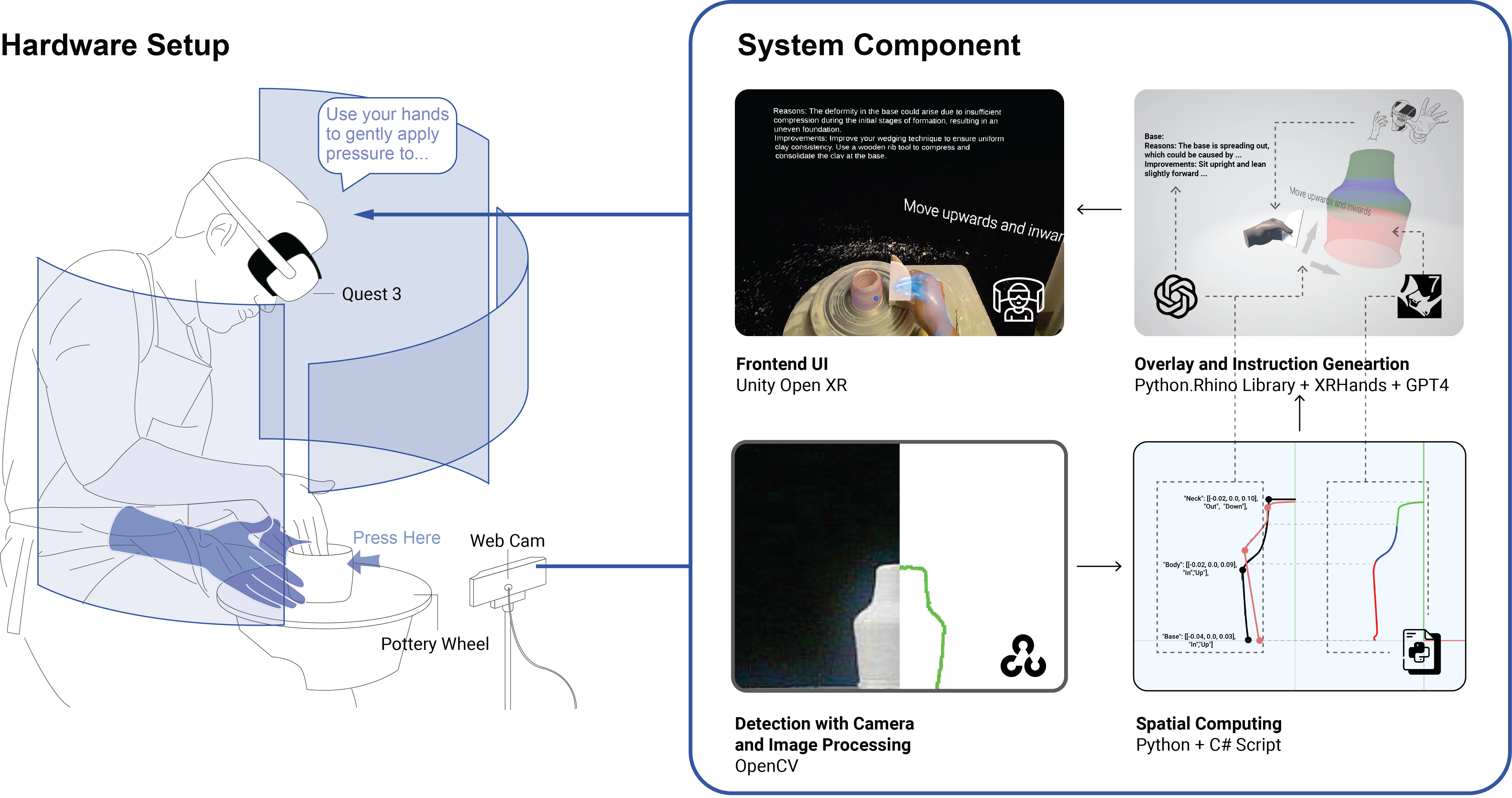
The ceramics guiding system comprises two main components: hardware and application. The hardware includes a pottery wheel, a webcam, and a Quest 3 headset as the display device. The software modules consist of a Python script for processing the detected shape and generating instructions via the OpenAI API, a piggybacked XRHand package for gesture recognition and guidance, and C# scripts for managing the learning process, including backend logic and the frontend user interface.
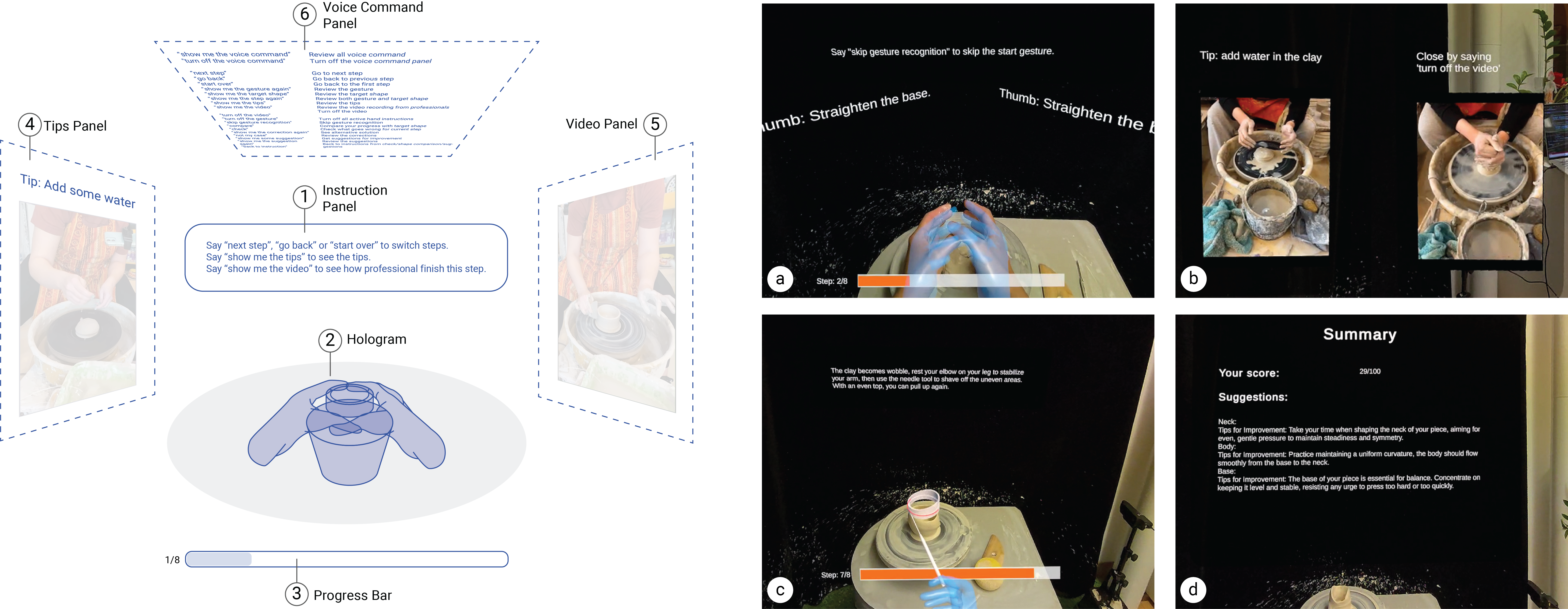
Novice system’s UI and functionality. Left: UI diagram for novices: (1) Instruction panel displaying all text-based instructions for the current step. (2) Hand and clay holograms for reference and imitation. (3) A progress bar to track learning progress. (4-6) Optional panels for video playback, tips, and voice command listings. Right: In-situ demonstration of system functionality in headset: (a) Gesture imitation with text-based instructions. (b) Video and tips-based guidance. (c) Rule-based correction using hands and tools. (d) Summary with scores and suggestions for the next session.
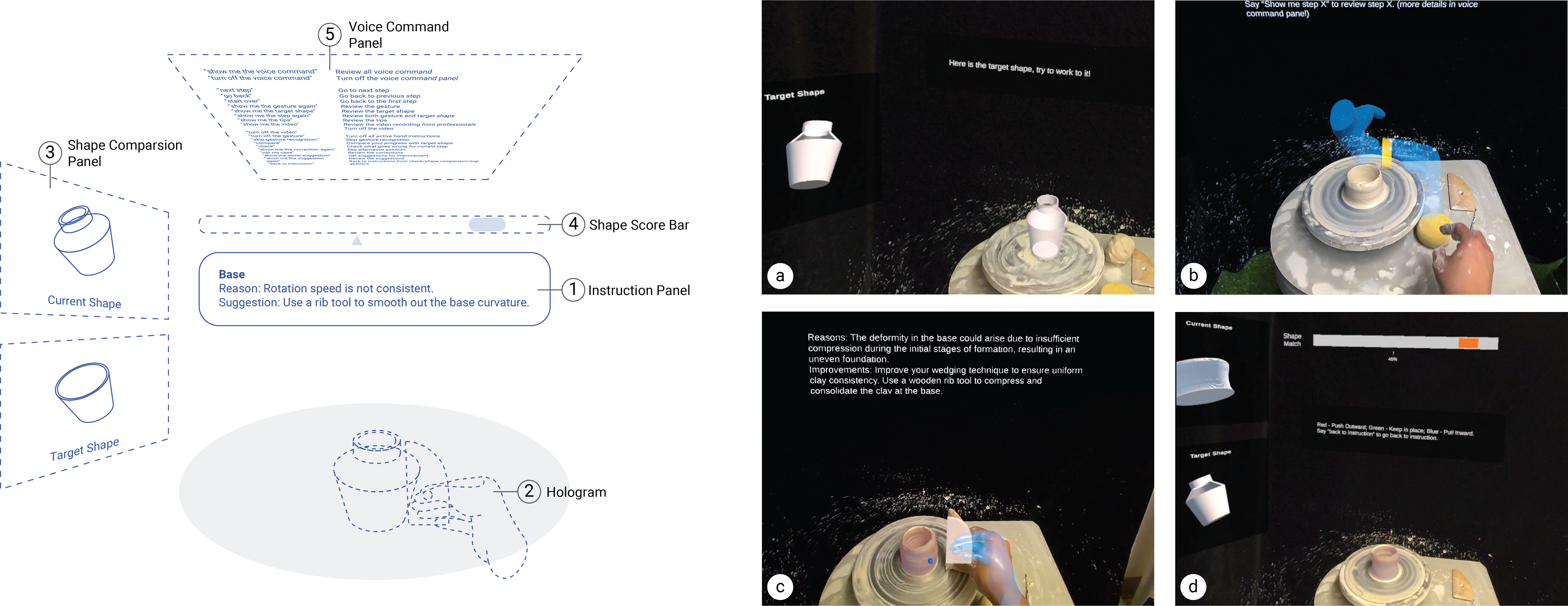
Experienced system’s UI and functionality. Left: UI diagram for experienced users: (1) Instruction panel displaying all text-based instructions. (2) Optional hand and shape holograms for skill refreshment. (3) Optional shape comparison panel to track the current clay shape. (4) Optional shape score bar indicating progress. (5) Optional panel displaying all available voice commands. Right: In-situ demonstration of system functionality in headset: (a) Practice goal and reference panels; (b) Recalled gesture hologram for skill review; (c) Multimodal suggestions with text, audio, and holograms; (d) Color-coded shape guidance.
FINDINGS
| Theme | Sub-theme | Description |
|---|---|---|
Tensions Between Virtual Instruction and Physical Environment | Video and Hologram as a Compound View for Embodied Craft Learning in MR |
|
| MR as Both Assistance and Obstacle in Physical Environments |
| |
System Workflow’s Impact on Craft Knowledge Transfer | Immersion Is Beneficial but Constrained by Skill Discrepancies |
|
| Autonomy for Craft Knowledge Acquisition |
| |
Need for In-Situ and Personalized Instructions Beyond Shape-Based Feedback |
| |
Perception on System’s Roles and Use Scenarios in Craft Learning | When and How to Use the System |
|
| Comparison Between the System and Human Instructors |
| |
Improvisation Is Limited by the Nature of Wheel Throwing and Skill Levels |
|
DISCUSSION AND IMPLICATIONS
| Theme | Sub-theme | Description |
|---|---|---|
Insights from System Design: Effective Strategies and Opportunities for Refinement | Designing for Craft Learning with Immersion in MR: Restoration, Reconstruction, and Augmentation |
|
Designing Instructions in MR: Detail and Hierarchy |
| |
Designing More Effective Communication Features in AI-MR: Modalities and Emotion Support |
| |
Insights Beyond Design Expectations: Emerging Patterns and Implications for Future Design | Designing Spatial and Motor Experience in MR: Instruction Distribution and Body Engagement |
|
Designing for Personalized Craft Learning in AI-MR: Bridging Skill Differences and Growth |
| |
AI-MR Systems Beyond Learning: Creation and Collaboration in Craft Making | Towards a Creative Craft Support System |
|
Evolving Roles and Speculative Applications of AI-MR in Craft Practice |
|